Blockchain

Explore how blockchain technology powers decentralization, transparency, and trust. From layer-1 protocols like Cardanao, Ethereum and Solana to smart contracts and immutable ledgers, Web3Wonders.us breaks down blockchain basics and breakthroughs — no hype, just insight.

Web 3 Functionality

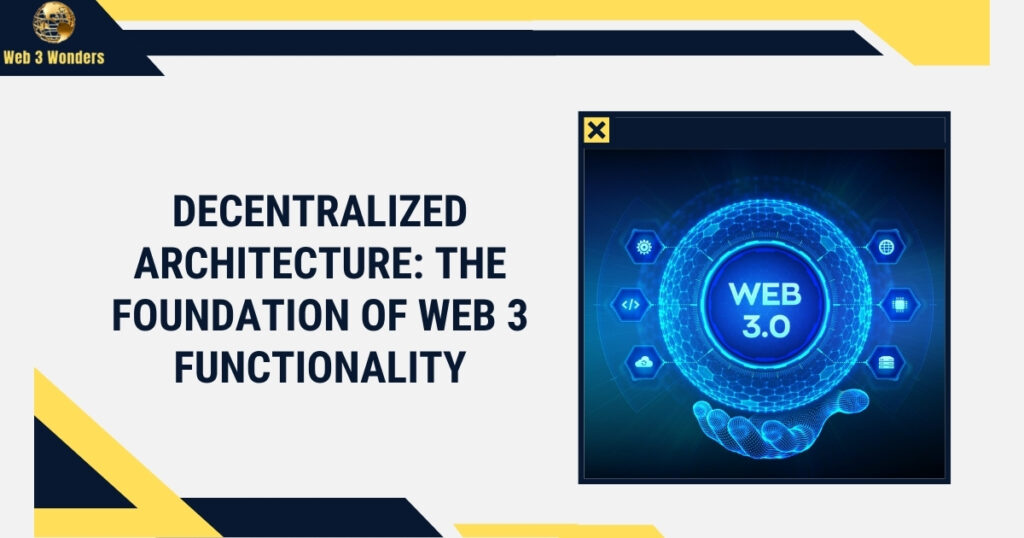
Decentralized Architecture: The Foundation of Web 3 Functionality

The evolution of the internet has gone through a lot- from static web pages to highly interactive platforms. Today, it has moved towards a more transformative phase known as Web 3. Decentralized architecture is at the heart of this change. It is a system design that takes away central control and spreads power across networks. […]

Decentralized Architecture: The Foundation of Web 3 Functionality Read More »

DeFi

Top 6 Advanced Decentralized Finance (DeFi) Trends to Watch in 2026

The financial sector is shifting rapidly due to the growth of Decentralized Finance (DeFi). This system offers businesses and individual investors access to capital that traditional banks and financial institutions won’t provide. From lending to trading, it accelerates everything and makes it more user-friendly. In 2026, the space is getting more advanced with new tools,

Top 6 Advanced Decentralized Finance (DeFi) Trends to Watch in 2026 Read More »

Cross-Border Payments

How Efficient Blockchains Are Transforming Cross-Border Payments

Cross-border payments have been one of the most complex and expensive areas of global finance. Basic international transfers often involve many intermediaries, higher fees, currency conversion costs, compliance delays, and settlement periods that can take many days.  Efficient blockchains are changing this reality today by amplifying decentralized networks, greater consensus mechanisms, and faster transaction processing.

How Efficient Blockchains Are Transforming Cross-Border Payments Read More »

Blockchain Technology

Top Real-World Uses of Blockchain Technology Beyond Cryptocurrency

Initially, blockchain technology was associated with cryptocurrency. However, businesses found later that it has greater potential to operate beyond digital currencies. Now, some leading organizations across the world have integrated blockchain into their business operations, bringing new capabilities, improving efficiency, and maximizing profit. Here, we will discuss some of the most innovative business use cases

Top Real-World Uses of Blockchain Technology Beyond Cryptocurrency Read More »

Blockchain Efficiency

How Smart Contracts Can Improve or Reduce Blockchain Efficiency? 

Smart contracts are a transformative innovation in blockchain technology. Self-executing agreements are stored on distributed ledgers and automatically enforce their terms when certain conditions are met. This automation minimizes reliance on intermediaries and manual processing, which can streamline numerous procedures. However, the way they are constructed and implemented also has ramifications for overall blockchain efficiency,

How Smart Contracts Can Improve or Reduce Blockchain Efficiency?  Read More »

Blockchain Fundamentals

Future of Metaverse Gaming: Blockchain Technology Behind Immersive Virtual Worlds

In the gaming industry, the rise of the metaverse is opening a new chapter. It’s a digital space where people can play, work, and live. Blockchain technology acts as the core of its revolution, bringing ownership, transparency, and security to the virtual world.  Unlike conventional games, blockchain-based gaming empowers players with NFT ownership, token earnings,

Future of Metaverse Gaming: Blockchain Technology Behind Immersive Virtual Worlds Read More »

Blockchain

The Great Convergence: How Finance Is Adopting Blockchain Efficiency

For a long time, banks used legacy systems that needed many middlemen and manual paperwork to move money. While people trust these systems, they are often slow and expensive. Recent industry research shows that traditional finance is increasingly aligning with digital asset infrastructure to modernize legacy financial systems. This helps them move money faster and more clearly.

The Great Convergence: How Finance Is Adopting Blockchain Efficiency Read More »

ADA Timeline Lifecycle

Cardano’s Next Steps: Overcoming Deficiencies for Web3

Cardano’s Evolutionary Leap: Navigating the Voltaire Era and Why Lace Mobile Can’t Wait
As we hit the midpoint of 2025, Cardano stands at a pivotal crossroads in its meticulously architected lifecycle—a blockchain born from peer-reviewed rigor, not hype. Remember the five poetic eras that define its journey? It started with Byron (2017: the foundational launch, establishing the federated network), evolved through Shelley (2020: unleashing decentralization via staking and Ouroboros PoS), ignited smart contracts in Goguen (2021: Plutus and native tokens enabling DeFi and NFTs), optimized for scale in Basho (ongoing: Hydra heads and Leios for million-TPS dreams), and now crests into Voltaire (2024-2025: full governance with CIPs, DReps, and a community treasury). This isn’t just incremental; it’s a symphony of sustainability, where each phase builds antifragility into the protocol.
But what’s next? Cardano’s 2025 roadmap is laser-focused on execution: wrapping Voltaire with a ratified constitution and elected committees for true on-chain democracy, turbocharging Basho scalability via merged mining with Bitcoin for interoperability, and prepping Leios for sub-second finality. The goal? Billions of users by 2030, starting with real-world pilots in Africa and beyond—think identity solutions via Identus and privacy dApps on Midnight. Metrics paint a bullish picture: as of June 2025, Cardano boasts 4.83 million unique ADA wallets (18% YoY growth), over 70% staking participation (securing 25B+ ADA), and 1.25 million active addresses monthly—outpacing many rivals in organic volume without bot-fueled TPS inflation. Daily transactions hover at 150K+, with TVL in DeFi hitting $800M, up 40% from Q1. Price-wise, analysts eye $2.46 average ADA by year-end, potentially $4 on ETF tailwinds and Chang hard fork momentum.
Yet, for all this promise, one bottleneck screams for urgency: Lace Wallet’s mobile rollout. Lace, IOHK’s light Web3 powerhouse, has nailed desktop—seamless dApp integration, NFT galleries, and multi-chain teases like Bitcoin DeFi. But in a mobile-first world (where 60% of crypto interactions happen on phones), its absence is a growth killer. Recent demos at RareEvo in August leaked a slick MVP: biometric logins, one-tap staking, and cross-chain swaps. The 18-month roadmap pegs public launch for Q4 2025, but community buzz (110K+ Midnight claimers using Lace already) demands ASAP—think Q3 to capture the 70% surge in mobile wallet queries post-Chang.
Why the rush? Metrics don’t lie: Cardano’s 18% wallet growth lags Ethereum’s 25% partly due to mobile friction—users flock to Yoroi or Eternl betas, but a native, audited powerhouse like Lace could add 1M+ mobile users in months, spiking adoption 30% via easier governance votes and DeFi onboarding. Delay it, and we risk ceding ground in the unbanked markets Cardano was built for. Lace mobile isn’t a feature; it’s the on-ramp to Voltaire’s sovereignty. Cardano’s lifecycle isn’t ending—it’s accelerating. Stake your claim, ADA holders; the poets would approve.

Cardano’s Next Steps: Overcoming Deficiencies for Web3 Read More »